Reflections on my visits to the Frick Madison and paintings that feel like old friends
If you were to leaf through the pile of red Moleskine notebooks that sit in a corner of my room, you’d find an interesting combination of content: annotations on readings for my seminars at school, random to-do lists for work or things I’m involved with, the occasional diary entry from when I’m feeling like a mess, all this next to each other in the same place. When I’m writing for myself my handwriting isn’t pretty, so you probably wouldn’t be able to understand most of it anyways. I write in black, blue or pink ink depending on what I have at hand, but there are many pages in my notebooks with barely readable scribbles in pencil. I hate pencils and refuse to write with them (I’m so stubborn I did all my economics problem sets and exams in college with a pen), but because some museums don’t allow pens in their galleries, I got into the habit of carrying a pencil in my purse. I started liking it and kept doing it because of one reason: I could easily distinguish my art notes from the rest of the rubbish I write in my journals.
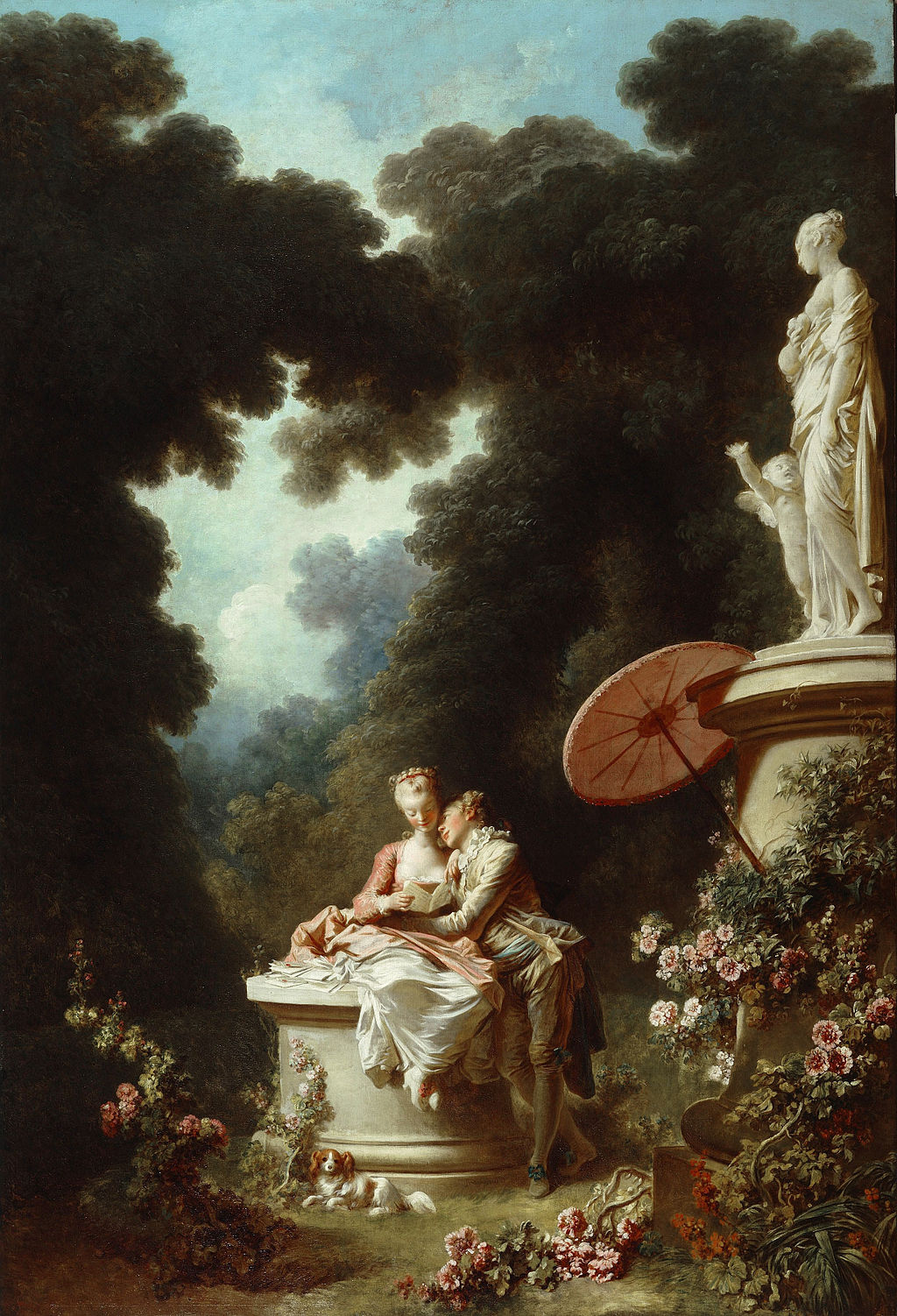
For the past four years, most of my art notes were freewriting or formal descriptions of works that I had to write an assignment about or that stood out to me in class. Sometimes it was pages and pages about a single work, other times it was just a few lines about a whole exhibition. I’ve written about many different things, but there is a group of paintings that I’ve revisited over and over in the pages of my red Moleskines. The Progress of Love (1771–1773) by French rococo painter Jean-Honoré Fragonard, on view at the Frick Collection in New York.
At the risk of sounding a little crazy, I like to say that there are artworks that feel like old friends to me. Paintings, sculptures and photographs–sometimes even artists, art currents or specific rooms in museums–that for one reason or another have stuck with me in a very particular way. Works that I feel attached to and remember dearly whenever I think about them, works that I like to visit in the museums that they are housed in whenever I get the chance, almost as if to catch up with them. Works that I can’t forget and that carry a special meaning for me that has more to do with myself than with the art. Works that I feel I have a connection to because I’m so sentimental of course I would feel that way towards inanimate objects that were created in a context completely unrelated to my existence. It goes without saying that The Progress of Love is one of them, and I would even say it’s one of my “closest” old friends when it comes to art I feel attached to.
I was eighteen years old and a freshman in college when I first saw The Progress of Love, back when it was still housed at the Frick Mansion on 70th Street and Fifth. I recall that evening very well. It was the Frick’s College Night and, to take advantage of the free admission, I went with the guy who would soon become my best friend. The museum had scheduled gallery programming that night, and Axel and I made it just in time for the curator talk on Fragonard. It was really just a coincidence that we stopped by that chat instead of any other, but it was because of that coincidence that my obsession with The Progress of Love began. I was drawn to the subtle shades of pink on those oversized canvases and the lavishly decorated room they were held in, immediately transported to a world of fantasy that resembled the fairytales I grew up believing in. The paintings were distinctly feminine, and I liked that. The theme was unequivocally romantic in nature, and inside that extravagant museum gallery, it was acceptable to indulge in that reverie. The works portrayed a fantasy that centered women and appeared to exist for their sensibilities rather than those of men. To my eighteen-year-old self, freshly arrived to New York full of illusion and hope, it was a picture of perfection, one that seemed too good to be true. And it wasn’t just a single image that represented this dream, but rather it was five large-sized canvases depicting different scenes where love reigned and Woman was the recipient of that affection coated with subtle sensuality and sweet tenderness. From that night on, Fragonard’s panels remained imprinted on my mind in a way that I couldn’t fully describe and for reasons that for a long time I couldn’t fully understand. The artist became one of the main reasons I kept returning to the Frick semi-regularly despite being more of a fan of modern and contemporary art.
Flash forward to my junior year of college, I took the literature and methodologies seminar that was required for all art history majors. The capstone project for the class was a research paper that could be about anything you could write an art history paper about: any artist, any artwork or group of works, any exhibition, any book, any curator, even any art historian. It wasn’t a very long paper, but we were meant to work on it throughout the entire semester. Picking a topic was a tough challenge, as we were allowed to write about literally anything we wanted. I distinctly remember sitting across from my professor during office hours brainstorming on possible ideas for my project. I had prepared a list of at least twenty random topic that I was interested in and started reading off it very quickly. Halfway through, right after I mentioned Fragonard’s paintings at the Frick, my professor stopped me and said “that’s it, there’s your topic.” She said out of the many ideas I had listed, my face had lit up when I mentioned that specific one. She observed that I had said “I’m not sure why but I’ve felt drawn to those paintings since I saw them.” She said, let’s explore that, that’s what you are writing about. And just like that, she made the decision for me, and I began working on what was to become my favorite paper of all of my undergrad.
Anyone who was friends with me during the spring of 2022 knows how obsessed I became with my paper. I would talk about the paintings and my feminist reading of them with whoever would listen to me rant about them. The plane ride to Florence and the first half of my spring break trip there were spent reading feminist theory and most of the academic literature on Fragonard. I would go to office hours almost every week to talk with my professor about the things I was reading and the new thoughts I was having. I was so invested in my paper because I loved the paintings but also because, just like my professor had asked me to, I was set on figuring out what it was about them that drew me so much. One of the things I loved the most about my professor was that she encouraged me to not write a traditional art history paper but rather to really use it as a tool for exploration. In particular, she was interested in me bringing in my personal experience into how I understood the paintings and trying to make sense of how these works from the 1700s resonate (or not) with contemporary audiences.
By the end of the semester, I had so much to say about the works that I ended up having to narrow down the scope of my paper to only one of the paintings in the series. I had thought about The Progress of Love from every possible angle my lovesick mind could think of. I read every single paper that was published about it, almost became an expert in 18th century French society gender norms, and came up with so many possible interpretations through a feminist lens. I ended up turning in a paper that I titled “What’s Love Got To Do With It? The Operations of Desire and A Feminist Reading of Fragonard’s Love Letters,” and I think that tells you everything you need to know about what my conclusion was regarding my inexplicable attraction to Fragonard’s paintings,
In her preface to Communion: The Female Search for Love, bell hooks rightfully asserts that, under patriarchy, women talk about love. She claims that women are obsessed with love not because love is an inherently feminine thing but rather because patriarchal culture forces women to define their worth based on whether or not they are loved. Women are taught to pretend “love” matters more than anything, even when that “love” is often just longing and desire for male approval in disguise. Female existence seems to revolve around this apparently incomprehensible yet ineffably beautiful concept of love, depicted everywhere from early 2000s romantic comedies and Taylor Swift’s discography to Jane Austen’s famous novels and glossy bridal magazines. Painting is not exempt from this type of idyllic representations of what love could be, and Fragonard’s panels are the prime example of these images of fantasy and desire. You could say my paper topic was born out of my personal experience as a woman who loves love and, consequently, my personal response to The Progress of Love. I remember during our initial in-class topic presentations I showed a slide with a picture of little 5-year-old Debbie dressed up in a pink princess dress during one of my birthday parties. I talked to my classmates about how Fragonard’s panels resembled all the representations of romance that plague popular culture and shape fabricated fantasies of love that cater to women, all which we are fed since we are little girls starting with fairytales and the Disney princesses (and whose equivalent in my early 20s are episodes of Sex and the City).
Whether loving love is feminist of me or not is a question I’ll probably battle with until the day I die and never come to terms with, but exploring it within the context of Fragonard’s paintings is something that I thought I might be able to do. It’s been 18 months since I started my Fragonard project and around 14 since I turned in that paper, but the importance of those paintings in my life hasn’t faded away. It was truly a journey through which I learned a lot about myself as an art historian and as a feminist woman but above all about the very human way in which one can engage with art. I return to these paintings when my soft heart is overflowing with emotion, whether that’s because it’s full of love or broken into a million little pieces. I sit and ponder in that gallery when I’m thinking about my decisions, whether I’m confused about the future or just had a recent breakthrough. I talk to them, not literally, but it feels as if I did. Once in a while I take a loved one to the Frick and share with them the random details that I know about the history of these works and my theories about them (shoutout to my mom, Nicole and Karina for being great listeners of my Fragonard rants). Fun fact, I submitted the application for the job I currently have after visiting my Fragonard friends, right in the basement of the building at the Frick’s little café (a hidden gem if you ask me). I believe in signs and I think that is one of them.
I know Fragonard’s panels will continue to remain imprinted on my mind, this time in a way that I can describe better than 4 years ago. This is the first but probably not the last time I’ll write about them here. The Progress of Love will continue to be one of the main reasons I keep returning to the Frick with such excitement despite having thought about Fragonard for one too many hours and disappointed with love one too many times. For the love of love, but maybe above all, for the love of art and the power it has to make me feel.
Yours truly y con mucho amor,
Debbie
 Art and Anticrises
Leave a comment