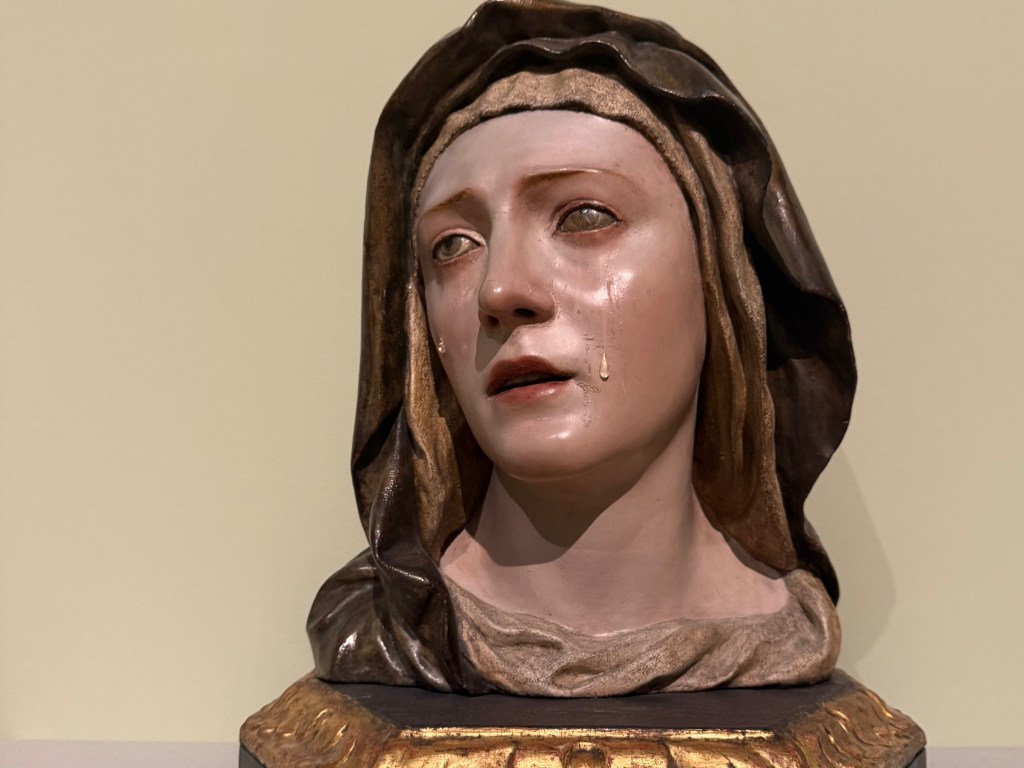
Despite the turmoil, despite being alone in a foreign country, despite it all.
Six months later but I finally came around to editing and collating my writing from my November travels. My Germany and Belgium two-week adventure was what my friends and I refer to as my “art and beer trip,” because that is really what it was. Over the course of fourteen days, I drank liters and liters of beer and completed 16 art visits (excluding public art and churches). I also spent a lot of time alone and was forced to think think think. The art visits were planned. The extent of introspection? Not quite.
I’m experimenting with a bit of a different format for this one – we shall see how it works (or if it doesn’t). This post will read more like a scrapbook of thoughts but they were so raw and beautiful and real-time. It was the first time I had traveled with art as the main intention (but certainly not the last one). It was also the first time I did a solo trip (my long weekend in Berlin was completely by myself and although brief I underestimated how that would feel). I cherish spending time alone and do so often, but this was different (and even difficult).
I cried a lot during this trip. Like a lot. More than usual (and I’m a crier). I left New York having made some much needed but difficult professional and romantic decisions that had me in complete turmoil. Germany and Belgium were an escape to sit with them (though when I booked my flights months prior, that hadn’t been my intention). In retrospect, I think both things were more massively symbolic than actually consequential. But I’ve found that in my life the former tends to have more emotional weight than the latter.
Anyways, here’s a (big) piece of my mind (and heart)! Anything in italics was written post-visit, reflecting on what I remember feeling and re-reading what I had made notes on during the trip (and looking at the pictures I took). Anything in regular font was written real time and edited in my very delayed process of putting this together.
Yours truly y con mucho amor,
Debbie
Städel Museum (Frankfurt) – October 30
The Kirchners are too loud for me. I think I see Winslow Homers multiple times but they never are.
The museum is the oasis I have been looking for since Saturday night. Italian restaurants in the Upper East Side play their music way too high sometimes. The Met is too crowded with families and groups trying to catch the rooftop view before it closes for the year. Central Park is too swamped with New Yorkers enjoying what is possibly the last beautiful Sunday of the season. My friends are too talkative over dinner and baking. The office is the busiest on Tuesdays and somehow everyone needs to speak to me right before I leave. JFK is the worst airport to cry in. Planes to Europe carry too many passengers. To be alone and to be in silence. The only two things I needed and probably the only two things you can’t find in the city that has it all.
I hate being in a place where I don’t speak the language. I really, really do. That was my first impression of Germany the moment I walked out of the Frankfurt airport. But in a museum I don’t have to speak. And I feel at home although I’m in a foreign country that I regret buying a ticket to because there’s nothing I hate more than breaking my routine.
It’s the quiet that I need. I’m alone except I’m not. It’s just the right amount of people, and a certain camaraderie that doesn’t really exist yet that cannot be denied fills the air between us.
It is but isn’t. It does but it doesn’t. That seems to be my theme of the week. Unexplainable contradictions that just are although they aren’t. I know I’m a trained art historian. I should know nothing is black and white. This—whatever this is that I’m going through—is nuanced shades of gray. Give me a few days and I’ll knock sense back into me. Just give me a few days.
I wasn’t going to come to this museum. I didn’t plan on any art visits until tomorrow when I get settled. You already know I’m going to call it fate.
I wonder what all these other quiet wanderers are doing here on a random Wednesday afternoon. The museum doesn’t seem like a tourist hotspot, and visitors are mostly alone or in couples.
I spot a group of children, tiny, sitting down on the floor while an old man with a white beard enthusiastically tells them God knows what wonders about the paintings their little eyes see. They get excited. I get excited. They move towards the gallery I’m in and suddenly I’m completely surrounded on all sides by small humans who don’t have either a clue or a care that there’s a tear-eyed woman sitting on the bench they have claimed their own. I have to stop writing for a second, stand up and leave for the gallery next door.
I look back at the children from the other room and I wonder if at least one of them will end up like me in twenty years time. Using a museum as therapy because Dr. Julissa can only do so much. Believing paintings can speak to me when my heart doesn’t know what to say. Finding words in canvases and hundreds-of-years-old golden frames to make sense of my godforsaken sensibility and the nuances of being a woman who both feels too much and fears too much. Perhaps the two worst things a woman can do.
I love how the collection’s pieces are tied to the museum’s history in the wall text. Their presentation is as much about the pieces as it is about the rooms, the building and the city that houses them. A museum as a home. Whose home? My home, the paintings’ home, culture’s home. Maybe the home of feelings and questions as well. Like mine, but not just mine.
And it’s not a small collection. And it is very varied. I was surprised. If this is what spontaneity rewards brave people with, maybe I should let myself be surprised more.
I haven’t eaten since yesterday. Or had coffee. When was yesterday? I should go.
–
It was an overwhelming feeling. That feeling of home. That’s all you need to know because I don’t think my notes during the visit articulated it as clearly as I felt it. I genuinely wasn’t planning on an art visit on Day 1, but I was walking somewhere, passed it and just felt called to enter. It was exactly what I needed after 11 hours in an airplane overthinking every single possible thing in my life. But I didn’t know that when I walked into the museum building. Coincidentally, I also ended up having an (unrelated) religious experience at the Frankfurt Cathedral. And a long phone call with my mom afterwards that ended up being one of the most revealing and healing conversations of our mother-daughter relationship. I was indoctrinated into the Catholic church for the first 18 years of my life yet I had never ever felt what I felt that night in Frankfurt. I’m still trying to make sense of it to this day.
So yeah. Thank you, Städel Museum, for fortuitously setting the tone to a trip I will remember forever. For preluding the first and potentially the only religious experience of my life. For reminding me that fate exists and that it finds you when you need it the most. And that nothing in the world makes me feel like art does.
Museum Ludwig (Cologne) – October 31
I didn’t like this museum that much, but there were some rooms and pieces that made me smile. And I really needed smiles today.
I liked yesterday’s a lot more, but that’s not fair to Ludwig because Städel set the bar really high and I’m not sure anything else on this trip can top the prelude to a religious experience and the setting of some of the most heartfelt realizations I’ve had about my personal relationship to art.
Poor Ludwig. But I’m grateful for the smiles (and the pleasant surprise of such a big art museum in Cologne). I love when art makes me smile.
The Giacomettis (how I love that man).
A Magritte I studied in my first art history class ever (back home in my hometown’s art museum, not in college).
A modern sculpture gallery with a view overlooking the city and the train station (full length glass panels on one side of the wall, peak fall foliage looking into the rooms).
A Sonia Delaunay next to a Robert Delaunay (and Sonia’s was three times bigger…). Reminded me of an exhibition I saw back in New York just a couple blocks away from me in the Upper West Side.
There were so many Picassos. So many. I kind of loved them today, even when I’m usually quite unbothered by their presence. The more I looked, the more I was astonished by how solid their Picasso collection was. And they had a bunch of what I secretly call the “goofy” Picassos, the ones that look like the magnet my mom used to have on our fridge growing up. Talk about making me smile in a museum gallery. There were also some of his painted pottery and sculptures, which was refreshing to see.
I liked how they highlighted Chargesheimer as a local artist from Cologne, one that is important to the world but that they are loudly proud of here, in his hometown. He died in 1971, but he would have celebrated his 100th birthday this year hence why they had the show on. I love the commemoration aspect of it. And his photographs of Cologne. I just arrived in town and it almost felt like they welcomed me to the city that will be hosting me in Germany.
The Kirchners. I liked them here (in comparison to yesterday). Maybe they didn’t feel as loud today. Maybe I’m better and more grounded today. They had so many, too.
I’m realizing that how the museum itself makes me feel is as important to me as the actual artworks the museum holds.
I appreciated the quiet today again. I can’t help but keep thinking about that feeling of being at home in a museum when I have never felt as foreign as being in this country.
It’s good to know that museums serve me as a place of refuge. A shelter, a haven, whatever you want to call it. I’m realizing I’ve known this for a while, deep down, it is just quite literal now.
Didn’t I run to The Met when I avoided conflict? Didn’t I run to The Frick when I was in love?
On the train to Berlin (early morning of November 1, I suppose)
On the train.
Being a child we experience so much wonder.
And I just realized that I find it in art as an adult.
Tener vértigo a lo bueno de la vida. I spend so much time being afraid. Good things feel scarier than bad things sometimes.
At the Berlin Cathedral (because for some reason I was in a cathedral state of mind all trip long)
The cathedral is gorgeous on the outside. And it is on the inside too, but although it is objectively more “majestic” than Frankfurt’s, it feels more fabricated (derogatory). And I don’t feel like I did in the other one. Protected and in the presence of God, words that read funny coming from me given my relationship to religion recently. Hmm.
Bode-Museum (Berlin) – November 1
There is something so contemplative about sculpture. I can’t quite put my finger on it.
The silence, again. Solace. I feel like I’m in the Petrie Court at the Met, which is my favorite place in the museum which is my favorite place in all of New York. I’ve cried so many times there. Sometimes when I was an intern there I’d go and discreetly shed some tears in the court during my lunch break. I reminisce on those moments sometimes, fondly.
I’m loving this place so much and I’m only getting started.
The visual language is different. I feel like, at least when it comes to sculpture before modernism, it tends to be more literal, even if often sculpture is allegorical. But the technique (wow). And the process (oof). And the choices an artist has to make in this medium to me seem a lot harder and even more intentional than in a painting. I am very possibly wrong, but I can’t articulate it better at this point in time.
There’s that religious theme coming up for me again. Somehow in the very first room of the Bode Museum I feel it ten times more intensely than in the Berlin Cathedral. What does that say about me? Or about the power of sculpture?
I love the colorful ones. They’ve been restored for sure. But still.
Canova, we reunite again. That one sculpture of a woman, graceful in an elongated pose. It caught my eye from afar the moment I stepped into the gallery. And I looked at the plaque and it was his.
Funny to run into you here. Of course it had to be you.
As I continued through the endless galleries of the museum, I began to be struck by a repeating theme.
The image of a praying woman. Of a pleading woman. Or of a Pietà. A woman pitying, being compassionate. Images of a mourning woman too. Sometimes all of the above intersecting in one single female figure or bust.
There’s so many of them and several sit so low, so close to the ground I’m worried. They are so old and fragile.
I was struck by them, emotionally, but also at some point intrigued by the sheer number of them I kept encountering.
Sometimes I don’t need to understand, I just need to wonder. That’s so important and, despite that, we forget about it frequently.
There’s so many sculptures of women. I can’t unsee them. I feel surrounded by them gallery after gallery.
In the Spanish sculpture room, I came across a bust of a virgin crying that blew me away like nothing else I’ve seen on this trip. Mater Dolorosa (polychromed wood, glass eyes, 1670/75) by Pedro Roldán (Sevilla 1624-1699 Sevilla). It was as if the tear was actually glistening the very second I was looking at it.
The bust was hauntingly beautiful and disturbingly tender like I find most grief to be. And in immaculate condition for a wooden object nearing 400 years of age.
I walked into the museum happy but the more I wandered through the galleries, the more my mind drifted off—and I started to feel a bit sad. Suddenly all I could see were the faces of sorrowful women everywhere in the sculpture galleries. Perhaps an art historical trope across centuries, perhaps a match to my state of arrival to Germany.
Berliner Philharmoniker (Berlin) – November 1
Giovanni Antonini conducts Mozart and Haydn
I did not make any notes before, during or after this visit, but it was so significant to my trip. I had dinner at a German restaurant and ordered two beers with my schnitzel. Awful idea. The beers sat terribly with my stomach (and head) because I was quite sad and almost hadn’t eaten anything in the three days prior. So I was slightly buzzed and both emotionally and digestively afflicted when I got into my taxi to the concert hall.
I felt like an outsider as I checked my coat amongst stylish Berliners who knew German while I did not, much like I’d been feeling like the biggest foreigner since setting foot in Germany. That didn’t help my state. Finding my seat was easy, but the guy sitting next to me was high as hell and the lady to my other side would just give me a demeaning side eye every other minute. That didn’t help my state either.
No wonder, I cried at the philharmonic. Big surprise, I left at the intermission. Despite it being the world-renowned Berlin Philharmonic and despite having paid for my ticket myself. Not because it wasn’t good and not because I was bored or didn’t like the program. I loved it—but I couldn’t stay. And while I don’t regret going, I also don’t regret leaving. I don’t have many secrets but this may be one of them. The alleged art lover who makes a big fuss about her cultural experiences stood up and walked out halfway through a performance of a calibre she may never witness again.
It felt symbolic in that moment—an act of free will.
I suppose I should have stayed. But going against that was a reminder that I can leave, walk away at any time if something doesn’t serve me. If I’m not feeling well. If I simply don’t want to be there anymore.
I don’t have to stay just because the concert has started, or because habit says I should, or because who knows. If choosing myself means leaving and that is what is best for me—then I can leave. And screw what anyone else thinks.
I wasn’t thinking only about concerts and performances.
Sometime during the very long guided walking tour of Berlin I did (November 2)
Being in Berlin is kind of like choosing myself and walking away. I know I should do it, but it’s fucking uncomfortable. And difficult.
Berlinische Galerie (Berlin) – November 2
Is she hiding her face or crying? Reclining Nude (oil on canvas, 1889) by Lesser Ury (Birnbaum 1861-1931 Berlin). I’m starting to think that the works I notice the most in galleries tend to be those that mirror myself in some way.
Today’s museum was silent but in a different way.
Berlin has a difficult history. I learned about that all day as part of a guided history walking tour of the city. And then I ended up at this museum that exclusively shows modern and contemporary art made in Berlin. Perfect though unplanned end to the day.
It was fateful. I really just decided to go to this museum today because the route made more sense from where I was at the tour ending location versus from my hotel, where I would have departed the next morning to come here.
The Berlinische Galerie didn’t make me swoon or sigh or contemplate, but I still enjoyed it. It was interesting and just the right size. My main takeaway was art as a way to cope with hardship (like many Berliners did living through the city’s tumultuous history, same as I do with my own silly and not-so-silly hardships). Art as a means to cope individually but also collectively—even if artists (or even viewers) are not explicitly collaborating or belonging to the same group or movement. Even if they exist and create or look in different epochs.
Giselle by Staatsballett Berlin (Berlin) – November 2
The opera house was beautiful, but, oh, their version of Giselle was truly wonderful. From the moment the curtains opened and I saw the set, I smiled and knew I was going to love it.
It was so theatrical and dramatic—the dance but also the costumes and the backdrop, everything about it. It was in the little details and twists. Those small creative liberties made a world of a difference, at least to my eyes.
I liked it even more than American Ballet Theatre’s version, I think.
The last time I saw Giselle was at the Met Opera House with my friend Ana Paula, a week after someone completely shattered my heart. I’d bought my lineup of summer ballet tickets well in advance, it just so happened that the one performance centered on heartbreak so devastating it leads to madness and death was scheduled right after my unplanned relationship status change. I cried, but I cried all the time that July so it wasn’t shocking to me—but to my friend it was. Ana Paula confessed to me shortly after that she kept looking over to my seat throughout the show and she’d just see the tears streaming down my cheeks. “Should she be watching this right now?” she told me she asked herself. “I was genuinely concerned about you, and the ballet’s storyline was not helping.” To this day, we laugh about it whenever we remember.
Somehow, this time around, Giselle also came just a week after a ‘breakup’—for lack of a better word. As I sat alone in the orchestra section while all the stylish Berliners walked around the opera house halls during intermission, I wondered what this could mean if it were a sign from the Universe. And if you know me, you can bet that I believed it was a sign.
—
So, for context, in Giselle the protagonist goes mad and dies of heartbreak. Honestly, so relatable, Giselle. Then she turns into a ghost—a “wili,” who are the ghosts of women who died because of the betrayal of their lovers before their wedding day. In the second act, all the wilis dance and it’s so beautiful (one of my favorite ballet dances ever). Giselle’s lover finds them, but the Queen Wili wants to destroy him—in this case, because he was an unfaithful little bitch already engaged to some princess when he met Giselle. But Giselle protects him because she still loves him. I’m oversimplifying but you get the point. Last year, I was SUCH a Giselle—right now, I don’t think I’m really being one. But maybe that’s why? A reminder from the universe to not be Giselle over a loser again? HAHAHA
Probably while I speed walked to a museum or waited in line (November 3)
Germany has a difficult history of suffering, horror and mistakes.
It commemorates it, good and bad. Owns up to it. Learns from it.
I have a difficult history of assault, mistrust, of running away from real intimacy and commitment. Of choosing people, friends and lovers, who don’t choose me. Of engaging in reckless behavior because I don’t know better. Of engaging in reckless behavior because I know I know better.
I wear my wounds and my mistakes on my sleeve as much as I wear my heart. Berlin seems to wear its own on its streets and the dozens of memorials and plaques that fill them.
There’s strength in that (in Berlin and I suppose in myself as well).
Neues Museum (Berlin) – November 3
Other than looking, I spent this visit thinking about whether or not there is a “correct” way to go through a museum, a “right” way to see a collection or exhibition. I concluded, I think, that there is not and that enjoying something so human as art shouldn’t have parameters to enjoy it “right.”
I saw the Bust of Nefertiti and WOW. I was actually blown away.
I don’t think I had ever experienced that with any of those big-ticket famous “masterpieces” museums hold so dearly (e.g. the Mona Lisa at the Louvre, the Starry Night at the MoMA).
I had terrible period cramps, but coming was so worth it regardless. I think if the Bust of Nefertiti were to be the one singular thing you liked in the museum, coming would still be worth it.
Such beauty and perfection. Why do we stare at things this beautiful for so long?
The museum was mostly Egyptian art and undoubtedly it is in my top three of the most architecturally beautiful museums that I’ve been to. It was interesting to observe so much wall text and hear so many audio guide bits on how many of the galleries were rebuilt or restored after the war—what remained, what was damaged, and what was changed in the restoration. And why. I hated my architecture lectures in school but this might have been my favorite part of today.
This museum was not quiet today, unfortunately for me. Quite the opposite. Apparently, Berlin museums are free for everyone on the first Sunday of every month, so it gets super crowded. Oh well!
Altes Museum (Berlin) – November 3
Three short notes from three different points in time during this visit. The last one might be my favorite note from the entire trip.
—
I’m feeling so Columbia Core Curriculum, ha.
Fucking West Turkey leave me alone.
–
Greek, Etruscan and Roman – cool, but why are all of these here?
–
I love tragedy, this is the perfect museum for me.
Kolumba (Cologne) – November 4
I feel like this is one of those places that I’m never going to forget. It was the art museum of the Archdiocese of Cologne? So unexpectedly cool. It juxtaposed old sacred art with contemporary works, had no object labels nor chronological or stylistic connections in the rooms.
I felt like an art historian in a playground—I could let my brain run run run. The building was beautiful and their printed museum guide was so well-written. Also the staff was so nice to me.
You know how I say that sometimes I like not understanding what I’m seeing? This was perfect for that (in the best of ways).
—
I think this was my favorite museum experience of the trip. My notes don’t capture how fascinated I was!
Wallraf-Richartz Museum & Fondation Corboud (Cologne) – November 5
From medieval and baroque art to early 20th century painting (plus an exhibit on the history of museums!). I went to this one only because my brother abandoned me to go drink with his friends for the afternoon, but I was very pleasantly surprised.
—
The security guards were so loud, and if I hadn’t made it clear yet, this trip I’m into silence and dread noise. But the museum was giving Frick Collection vibes, and that I can’t complain about.
I like the way they pose questions in the wall text and object labels. They’re good questions, too.
Odilon Redon.
Made me smile. I think there’s a work by him at the Met that I love.
A beautiful Munch made me sigh.
I feel like a Munch painting nowadays, just melting into my emotional state.
Ah, I remember how I used to love him and what the Expressionists stood for. Used to?
Lots of pretty albeit not that significant Impressionist works. Lie, they have some beautiful Monets. Lie?
I enjoyed the medieval section despite most of it being religious art, which I’m not fond of most of the time. I was drawn by how the collection was mostly medieval but from Cologne and how the galleries explained different time periods and styles in relation to the city’s history (and art history!).
Heroes, saints and martyrs. Timeless?
I am actually so surprised. I normally sprint through medieval art galleries but I actually really enjoyed it here, even took my time (I really never do with medieval works). There was so much good exhibition text, an excellent logical sequence and quite interesting framing. The fact that there wasn’t an overwhelming number of paintings per room (nor in the entire floor) also helped. The collection felt accessible, digestible, easier to get through.
Kuntsmuseum Bonn (Bonn) – November 6
I liked, as an idea, that one of their main exhibitions was on German Expressionism but specifically on the way it developed in the region that Bonn is located in. But the works themselves didn’t say much to me (and also all the text was in German so I also couldn’t understand anything, literally). Leaving the language barrier aside, visually they just didn’t do that much for me. Didn’t stir up emotion, didn’t get any points across. Didn’t even confuse me, unfortunately.
The retrospective though, I enjoyed a lot. The painter depicted a lot of women and I always love looking at that and thinking about that. But I just also loved his style.
He leaned a bit towards abstraction but not really since it’s quite clear what he is formally depicting.
He was always using the same palette of muted colors but I love it—grays and desaturated shades of orange, blue, purple, etc. It works really well.
It’s so interesting when he depicts women in pairs.
I love how he plays with the blank sections/white spaces/unpainted parts to create texture and sometimes even give contour to things. He plays with the “unfinished” not just so it looks unfinished but to produce an intended visual effect that adds to what is being depicted.
Now that I think about it he depicts everything in pairs, actually. I love that as an idea.
Magritte Museum (Brussels) – November 8
My stay in Belgium was significantly shorter than my stay in Germany, and I was with my brother the whole time (well… most of it). So I had less alone, think-and-jot-stupid-thoughts time and, as a result, I didn’t write much. But that is not to discredit how much I loved Belgium and how meaningful my art experiences here were, it was merely circumstantial!
I actually liked Belgium a lot more than Germany but, art-wise, I can’t fairly say my visits were more special in one country than in the other. I’d say Germany’s art experiences were more feeling-inducing (though that might have been because of my emotional state) and Belgium was a bit more question-arousing and nostalgic (I’ve always been mysteriously drawn to Flemish and Dutch art and this trip made me even more curious, plus I had a few run-ins with painters or paintings that mean a lot to me and that was wonderful).
—–
Sixteen-year-old Debbie would be crying of happiness. I used to be obsessed with René Magritte and had Brussels at the top of my bucket list precisely because of this museum. I outgrew that surrealism-loving phase a long time ago, but it still means a lot to me because of how significant he was to my personal history of engaging with art history.
They had many, many works, just not any of the important or well-known ones. Despite that, it was still lovely to walk around a museum dedicated to just him, and there were so many quotes by him around the galleries that you could learn about his philosophy of life and art as you saw his paintings.
This visit reminded me of why I fell in love with him in the first few months of my art history education when I was in high school. Somehow I could understand all the phrases (they were all in French and I didn’t think I’d still have it).
The Lamb of God by the Van Eyck brothers at St. Bavo’s Cathedral (Gent) – November 9
Wow. And I’m not even a fan of religious art.
Musée Oldmasters Museum (Brussels) – November 10
So many Frans Hals. I don’t think I realized how much I liked him until I wrote this down.
I always love and am so intrigued by the Dutch painters. During this visit, something I was specifically drawn to is how they represent old women. I’m indifferent to all the portraits of fine ladies that many painters completed commission after commission. I don’t really like them nor do I think they are particularly beautiful (even if craftwise many of them are “masterpieces” by Western art technical standards). But old women in Dutch portraits tended to be depicted with nuances hardly found in other subjects. The best I can do to articulate it is to say that they were painted so humanly to a rare extent.
Today feels like a day I would go to the Frick. Except the Frick has been closed since March for renovations and I’m in Belgium, not in New York, so I couldn’t even walk past the building if I wanted to. It’s funny I’m thinking about this because the Frick Collection has some good Dutch works and I was just writing about them.
I love Dutch portraits of men. Otherwise I think painting men—as in, the portrait of just a man—is stupid (I’m sorry I’m not sorry). But not these. I love to look at them.
The Death of Marat. Gave me chills. Its presence in a room does not compare to looking at it in a picture or even a printed textbook. The blood—on the body and the knife and the sheets and the letter—is the most distinctive feature of the painting. But it’s the type of detail you pick up on a completely different level when looking at it in person. The scale, the detail and the way somberness is so well conveyed by Jacques-Louis David. And if you look at the canvas it is as if it goes from light on the top right to darkness on the left towards the figure. Qué maestro.
Nice to meet you, Marat. I wish there had been a bench in front of you (and I usually never need the benches).
The Rubens didn’t hit as much as I thought they would. The Bruegels definitely did though (and the Boschs too).
Verdi’s Requiem produced by La Monnaie at Bozar (Brussels) – November 10
You probably think you don’t know what this is if you read the name, but if you hear it, you definitely know it. The first time the famous section played gave me chills (sorry I don’t know music terms).
Groeninge Museum (Brugge) – November 11
¡La última y nos fuimos! More Flemish art today (and my brother waited outside the museum doing literally nothing because that sounded better to him than walking through the galleries with me).
Almost certainly on the train back to Brussels from Brugge – on a note on my phone I titled “lessons germany and belgium” (November 11)
Listening to my therapist is sooo easy if I just put myself first (that is the hard part I suppose).
I’m learning to practice self-compassion, and I’d say that was one of the big themes of this trip. When your heart is heavy, or when that beer with dinner didn’t sit well with you and you have to leave the Philharmonic.
At the Brussels airport before getting on a flight to JFK
How lucky am I to have so much to go back to in New York.
 Art and Anticrises
Leave a comment